A Mental Health and Rights-Based Perspective on the Proposed Transgender Persons (Protection of Rights) Amendment Bill 2026
As a mental health organisation, Mariwala Health Initiative is deeply concerned about the troubling shift from the rights-based framework for transgender people in India. The removal of self-perceived gender identity recognition and the introduction of certification processes requiring medical boards and administrative review risks — turn a protective law into a deeply harmful regulatory law.
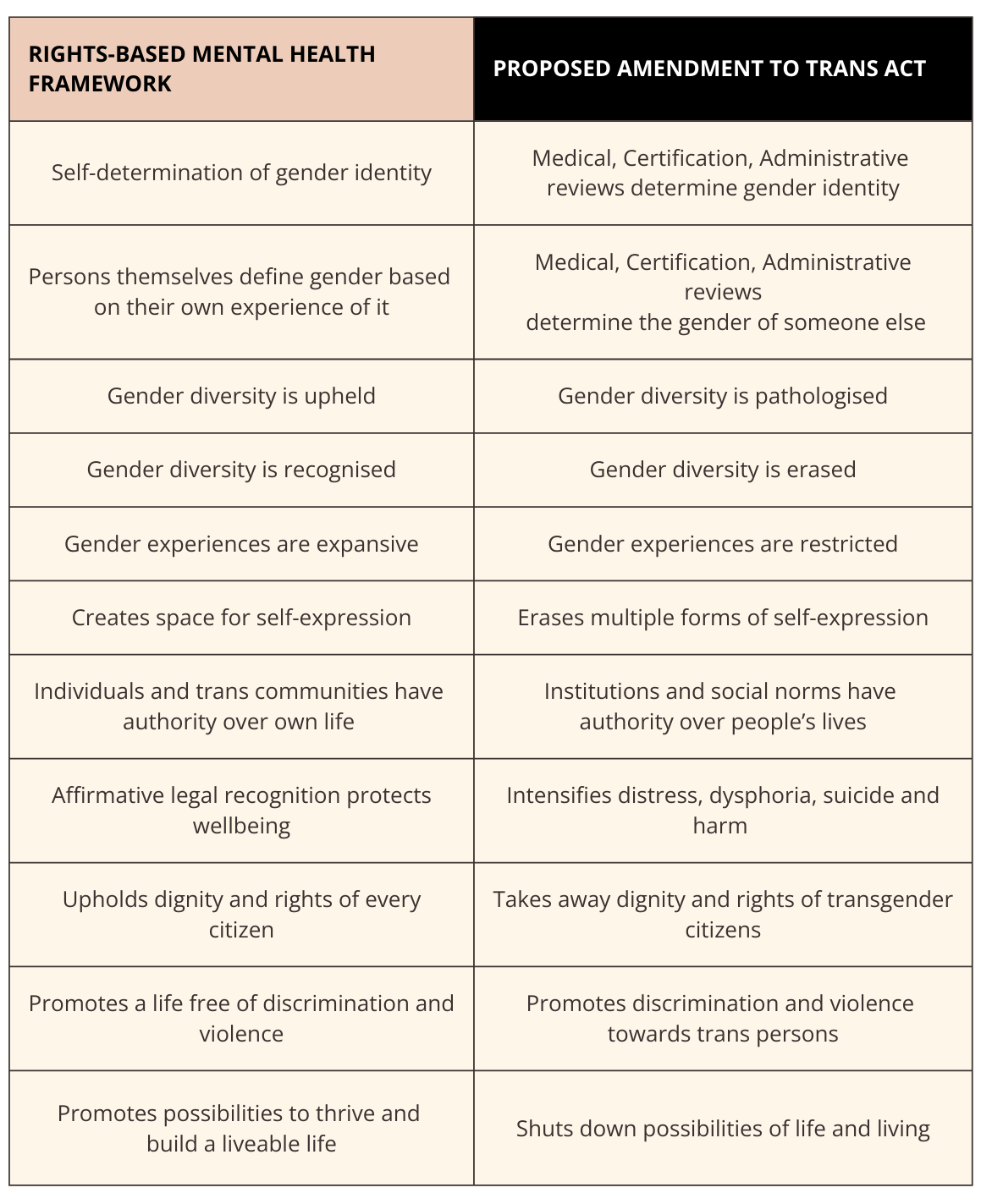
Legal recognition that supports self-determination is a protective mental health factor. Frameworks needing proof or medical certification often have a detrimental effect, risk and harm.
1. Constitutional Principles of Self-Determination
The right to determine one’s gender identity was affirmed in the landmark National Legal Services Authority v. Union of India (NALSA) decision, as it recognised gender identity as part of the constitutional rights to dignity, autonomy, and equality. The amendment undermines this principle by replacing self-identification with certification processes managed by medical authorities and district administrations. This change isn't just about procedures but about the shift towards medicalised verification of identity. It repositions transgender identity as something validated by the state and medical institutions, not by individuals. From a rights perspective, this is very concerning and has several consequences.
2. Institutional Gatekeeping
The amendment reinforces the obsolete and harmful idea that gender diversity is a pathology needing diagnosis. It shifts authority over identity from trans communities to institutions that have historically discriminated against them. Mental health research has long emphasised that gender diversity is not a pathology. The primary drivers of psychological distress among transgender people are stigma, discrimination, and institutional invalidation, which lead to structural exclusion.
Policies that intensify scrutiny and control over identity risk exacerbate these harms.
From a mental health perspective, affirmative legal recognition protects wellbeing, while gatekeeping mechanisms do the opposite.
3. Erasure of Gender Diversity
The amendment narrows the definition of transgender identity, excluding many, like trans men, trans-feminine communities, non-binary individuals, and others with multiple marginalisations. Additionally, the amendment makes troubling conflations between intersex and transgender identities.
Such a narrow definition risks erasing the very diversity the law aims to protect.
From both a mental health and rights perspective, recognition should expand space for self-expression, not limit it.
4. Mental Health Consequences of Legal Exclusion
The implications of such legislation extend far beyond administrative procedures.
Legal invalidation often leads to:
- barriers to accessing healthcare
- denial of educational opportunities
- exclusion from employment
- increased exposure to violence
These structural barriers are social determinants of mental health, and as a mental health organisation, we assert that such legal invalidation will contribute to:
- loss of dignity
- erasure of identity
- increase dysphoria without access to services
- increased suicidality
- increased isolation
- hypervigilance
- loss of social supports
- anxiety
- distress
- Amplified Marginalisation
Mental health requires legal frameworks that reduce stigma, not reproduce it. The amendment risks deepening the inequalities that create mental distress.
5. Community Voices Must Lead Policy
A law affecting a marginalised community can't be developed without that community’s leadership. Consultation after drafting is not participation; policy affecting a marginalised community must be developed through meaningful co-creation with that community. As disability justice and mental health advocates, we have always asserted the principle of Nothing about us, without us.
We ask for this to be referred to the Standing Committee on Social Justice & Empowerment so that trans communities can be heard and included.
India, which once led with the progressive NALSA judgment, risks moving in the opposite direction.
India's legal and constitutional journey on gender identity — from recognising privacy and dignity to affirming self-determination — has been a significant step forward.
The proposed amendment risks undoing much of that progress.
At a time when the world is increasingly acknowledging that gender identity is a matter of personal autonomy and human dignity, India should be strengthening protections for transgender persons, not weakening them. We stand in solidarity with transgender communities and ask for more voices in mental health and civil society to speak up.
As an MHP, I am willing to support the trans community by -
- Signing the statement to show support - Click here
- Providing low-cost/free counselling services to persons experiencing distress as a result of this Amendment for a period of 3 months. Click here
- Donating an amount to support efforts by trans communities to stop this amendment. Click here
- Creating visibility on social media using this toolkit. Click here
We are building a public database of Mental Health Practitioners offering low-cost/free services. Click here to access it.
“At a time when the world is increasingly acknowledging that gender identity is a matter of personal autonomy and human dignity, India should be strengthening protections for transgender persons, not weakening them.”